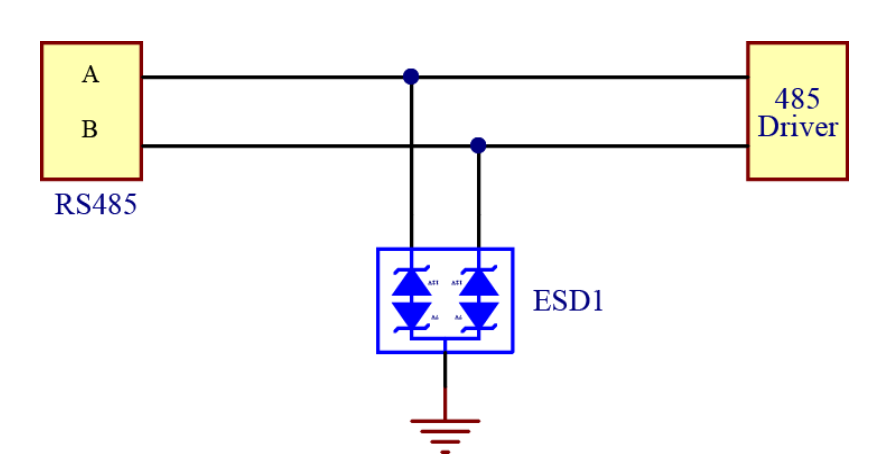
Protective Application of the SM712 Electrostatic Protection Device in RS485 Ports
2025-11-25In practical applications in industrial, power, automation, and instrumentation fields, the RS-485 bus standard is one of the most widely used physical layer bus design standards. Since it operates in harsh electromagnetic environments, these data ports must comply with relevant electromagnetic compatibility (EMC) regulations to ensure proper functioning in their final installation environments.
SOCAY's ESD protection device SM712 features the following specifications: VRWM (Voltage Reverse Working Maximum): +7V to +12V; typical clamping voltage of 30V at IPP = 12A; typical clamping voltage of 18V at IPP = 17A; ultra-low leakage current of 1μA; static capacitance of 75pF. It complies with protection standards IEC 61000-4-2 and IEC 61000-4-4, offering electrostatic protection up to ±30kV of air discharge and ±30kV of contact discharge. Additionally, it adopts a compact SOT-23 package with dimensions of 2.8 × 1.2 × 0.9 mm, and is halogen-free while complying with RoHS and REACH standards.
The unique feature of the SM712 lies in its asymmetric breakdown voltage of +13.3 V and –7.5 V, which matches the +12 V to –7 V transceiver common-mode range of the RS-485 chip ADM3485E. This provides optimal protection while minimizing overvoltage stress on the RS-485 transceiver. The SM712 can replace competitor models such as the SDT23C712L02、PSM712. Currently, it is widely used in HFC systems, RS485 transceivers, ATMs, security systems, networks, and other applications.